



Opinion | AI national resilience: how Lithuania’s security mindset is shaping its tech future
This article was written by Diana Girdenytė, Strategist at Invest Lithuania
Key takeaways
- Lithuania is positioning artificial intelligence as a tool for national resilience, not only productivity.
- Strong digital infrastructure, cybersecurity expertise, and defence innovation make the country a practical environment for resilience-focused AI.
- AI can help public institutions detect risks earlier, protect essential services, and respond faster to disruption.
- Lithuania recorded 25% fewer cyber incidents last year than in 2024.
Lithuania sits on NATO’s eastern flank while operating a highly digital public sector and a fast-growing technology ecosystem.
That combination makes the country a relevant case study for using AI in national security. In Lithuania, artificial intelligence is not only a productivity tool. It is becoming part of national resilience – helping protect digital systems, public services, infrastructure, information integrity, and defence capabilities.
The country is gradually building a whole-of-state digital resilience model, where AI, cybersecurity, infrastructure, governance, and public trust are treated as interconnected parts of national security. According to Lithuania’s latest National Cybersecurity Status Report, 2,888 cyber incidents were recorded in 2025 – 25% fewer than in 2024.
Artificial intelligence is becoming part of national resilience strategies
Artificial intelligence is increasingly used by governments to strengthen cybersecurity, defence capabilities, public services, and crisis preparedness.
AI can process large volumes of data, identify patterns, detect abnormal activity, and support faster decisions. In resilience contexts, this matters because institutions need to spot risks early, coordinate quickly, and keep essential systems running.
AI resilience means using artificial intelligence to help institutions prepare for, respond to, and recover from digital, physical, and information disruptions. Unlike productivity AI, which improves efficiency, resilience AI protects systems that societies depend on: government services, critical infrastructure, digital identity, communications, financial networks, and trusted public information.
Why Lithuania’s geopolitical context matters for AI national security
Lithuania’s geopolitical context makes resilience-oriented AI adoption especially relevant.
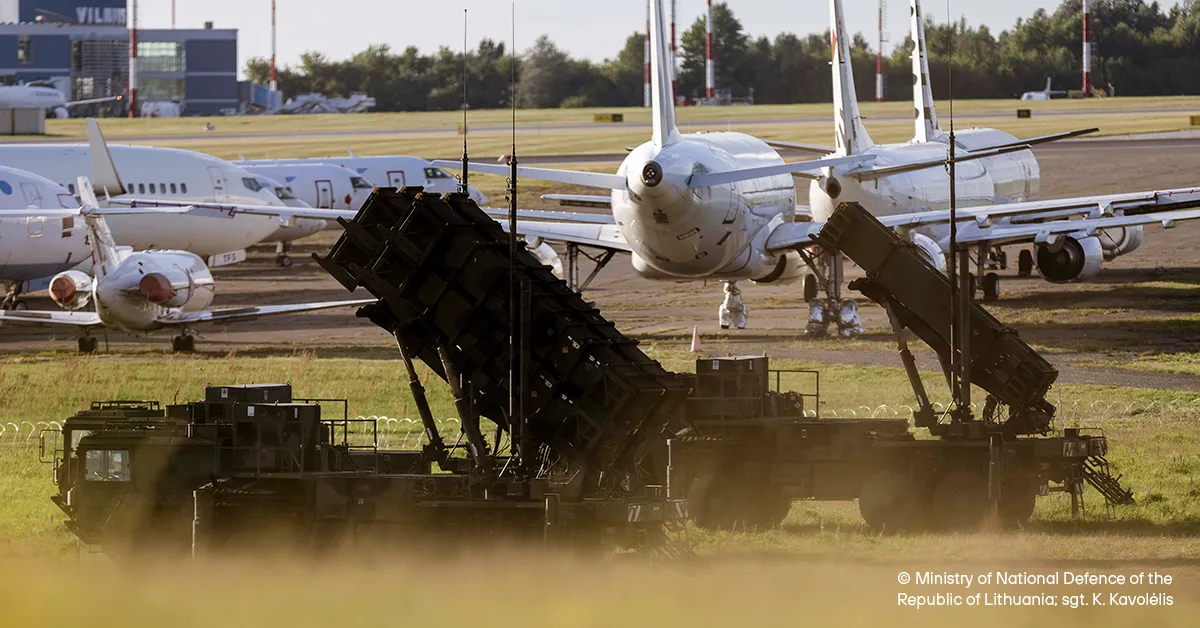
As a NATO and EU member, Lithuania is part of Western security, regulatory, and digital frameworks. Its location next to Russia’s Kaliningrad region and Belarus also makes cyber resilience, information resilience, and infrastructure continuity core parts of national preparedness.
It makes AI useful across several domains modern states need to manage at once: cybersecurity, public services, information integrity, defence innovation, and critical infrastructure protection.
Lithuania’s National Cyber Security Centre coordinates cyber incident management, monitors cybersecurity requirements, and supports national preparedness. For more on Lithuania’s security and NATO context, see Is Lithuania safe? Security measures and NATO membership explained.
How AI is used in cybersecurity and defence
AI technology used in national security includes cyber threat detection, anomaly monitoring, fraud prevention, infrastructure protection, predictive analytics, disinformation monitoring, and autonomous defence systems.
In cybersecurity, AI can support malware analysis, detect unusual network behaviour, prioritise alerts, and help teams respond faster. AI threat detection is especially useful when institutions need to monitor large volumes of data and separate routine activity from potential risk.
AI is becoming both a vulnerability multiplier and a resilience enabler: it can scale phishing and fraud, but it can also improve monitoring, intelligence analysis, and incident response.
Cyber resilience is only as strong as the wider ecosystem. One weak link can disrupt services beyond a single institution. That is why cybersecurity resilience depends not only on advanced tools, but also on shared standards, institutional readiness, and coordinated response.
AI in government: how public institutions are strengthening digital resilience
For public institutions, AI can improve situational awareness across complex digital systems. It can support data monitoring, anomaly detection, document analysis, cyber threat scanning, and faster response to emerging risks. In government operations, its value is not only automation, but better decision-making under pressure.
In Lithuania, this is especially relevant for public service protection and crisis management. Essential services depend on secure data access, resilient communications, backup environments, and continuity planning. The core idea is simple: digital infrastructure is now part of national defence infrastructure.
Lithuania’s National Cyber Security Centre coordinates cyber incident management, monitors cybersecurity requirements, and supports national-level preparedness. Threat scanning, anomaly detection, data monitoring, and coordinated incident response are becoming central to public-sector resilience.
AI is also relevant beyond technical infrastructure. Public institutions increasingly need tools to monitor complex information environments, including social media activity and coordinated manipulation attempts, while ensuring that AI use remains transparent, accountable, and rights-based.
Lithuania’s AI Strategy 2021-2030, revised in 2025, frames AI adoption around public-sector use, responsible governance, innovation, and long-term competitiveness.
For a broader view of Lithuania’s digital and physical infrastructure, see Lithuania’s Infrastructure: Transport, Energy & Innovation. Lithuania’s AI policy context is also covered by the European Commission AI Watch Lithuania profile and the OECD AI country profile for Lithuania.
Information resilience: using AI to counter disinformation
Information resilience is a nation’s capacity to identify, counter, and recover from disinformation campaigns targeting public trust and democratic institutions.
AI is changing how information is created, distributed, and verified. Synthetic content, deepfakes, automated amplification, bot activity, and AI-generated narratives can make harmful information spread faster and appear more credible.
AI can also help monitor information environments by identifying patterns, detecting coordinated activity, and supporting fact-checking or strategic communication work. In Lithuania, institutions such as the Lithuanian Armed Forces’ Strategic Communication Department contribute to monitoring hostile information activity and strengthening public resilience against manipulation.
For Lithuania, AI governance is linked not only to innovation policy, but also to democratic resilience, public trust, and institutional continuity. In September 2024, Vilnius hosted the signing of the Council of Europe Framework Convention on Artificial Intelligence, Human Rights, Democracy and the Rule of Law — the first legally binding international treaty in this field.
Defence AI: from concept to deployment
In 2024, Lithuanian company Granta Autonomy secured a €1 million contract to supply AI-powered FPV drones to both the Lithuanian Ministry of National Defence and Ukrainian forces.
The contract shows how Defence AI is becoming a practical capability. Granta Autonomy’s GA-10FPV-AI drones are a concrete example of AI-enabled defence technology being developed and procured in Lithuania.
Defence AI can include autonomous systems, computer vision, battlefield analytics, logistics optimisation, sensors, secure communications, and decision-support tools. For Lithuania, these technologies are relevant to military modernisation, dual-use innovation, and the growth of a domestic defence industry.
Lithuania has pledged to raise defence spending to 5-6% of GDP in 2026–2030, increasing demand for drones, sensors, cyber defence, and AI-enabled systems. As a NATO ally, Lithuania is aligned with NATO’s revised Artificial Intelligence Strategy, which sets principles for responsible AI use in defence.
For more on the country’s defence ecosystem, see Lithuania’s defence startup and Lithuania’s approach to growing the defence sector.

What makes Lithuania’s Defence industry stand out?
Explore a fast-growing ecosystem where advanced tech, state investment, and a skilled workforce drive innovation in telecommunications, lasers, sensors, and next-gen military equipment.
Lithuania’s growing AI and cybersecurity ecosystem
Lithuania’s AI and cybersecurity ecosystem is increasingly relevant to resilience-oriented innovation.
The country has strong foundations in digital infrastructure, engineering talent, fintech, cybersecurity, and startup development. Companies such as Nord Security and Cast AI show Lithuania’s ability to build globally relevant technology businesses, while defence tech is gaining momentum as dual-use innovation becomes more important across Europe.
This broader AI base matters because security-relevant technologies depend on talent, infrastructure, data capabilities, and practical deployment experience. AI national security requires cooperation between public institutions, startups, universities, defence companies, cloud providers, cybersecurity specialists, and international partners.
Recent European AI adoption rankings also place Lithuania among notable European markets for AI adoption momentum.
What the Baltic model means for Europe’s AI security agenda
Lithuania, Estonia, and Latvia are strengthening the Baltic Defence Line along NATO’s eastern flank while investing in cyber resilience, digital infrastructure, and trusted public services.
The Baltic approach treats resilience as a connected system, linking physical defence, cyber preparedness, infrastructure continuity, information resilience, public-sector digitalisation, and democratic trust.
For Lithuania, this creates a practical model for security-first AI adoption: AI is used not as a standalone technology, but as part of a wider resilience architecture.
For Europe, the lesson is clear. AI and national security are not only about military applications or advanced algorithms. They are also about governing AI responsibly, protecting critical infrastructure, sharing threat intelligence, maintaining public trust, and keeping essential services running.
EU regulation is moving in the same direction. The AI Act, the NIS2 Directive, and the Cyber Resilience Act all point toward a future where AI governance, cybersecurity resilience, and institutional accountability become central to national competitiveness and public trust.
What’s next for AI and national resilience?
AI is becoming part of the infrastructure of national resilience.
Lithuania’s approach is not only reactive. It reflects a security-first technology mindset in which AI, cybersecurity, infrastructure, governance, and public trust are treated as connected priorities. The next stage is execution: secure AI deployment, trusted data governance, stronger cyber hygiene, resilient communications, clearer institutional responsibilities, and closer public-private cooperation.
This creates an opportunity for Lithuania within Europe’s resilience ecosystem. The country does not need to compete through scale alone. It can compete through agility, trust, interoperability, and close alignment with EU and NATO frameworks.
As quantum-era cybersecurity risks, AI-generated manipulation, the Cyber Resilience Act, and AI governance reshape Europe’s digital agenda, Lithuania’s role will depend on turning resilience from a policy ambition into a practical operating model.

Enjoy reading our news?

Want to learn more about the latest updates?
Invest Lithuania is here to keep you informed about the latest news, opportunities, and developments shaping Lithuania’s business landscape. If you have any questions or would like more details, feel free to contact us—we’re here to provide the insights you need.
- Share now:
-

-

-

-
