



Opinion | Fintech M&A in Europe: why global players are acquiring local companies
This article was written by Deimantė Žemgulytė, Senior Investment Advisor for Technology sector at Invest Lithuania
Key takeaways
- Fintech M&A in Europe is accelerating as companies seek scale, regulatory infrastructure, technology capabilities and market access.
- According to McKinsey, global fintech M&A more than doubled in value in 2025.
- Recent acquisitions involving Lithuania-linked fintech companies include: Checkout.com/Blue EMI, Ebury/ArcaPay, Zilch/Fjord Bank, and Lloyds/Curve Europe.
- Lithuania is one of the EU’s leading fintech hubs by number of licensed companies, making its regulated firms increasingly attractive acquisition targets.
Fintech is entering a consolidation era
Fintech M&A in Europe is accelerating as the industry enters a new phase of consolidation. At Money20/20 Europe 2026, one theme was hard to miss across panels, side events and industry conversations: the fintech industry is consolidating.
After a decade of rapid expansion, many fintech companies are now under pressure to achieve scale, strengthen profitability and build more resilient regulatory and technology infrastructure.
For global players, acquisitions are becoming a faster route to growth than building every capability internally. Instead of developing licences, compliance teams, payments infrastructure or distribution networks from scratch, companies are increasingly acquiring fintech businesses that already have these assets in place.
This trend is especially relevant for Lithuania. Over the past decade, the country has developed one of Europe’s most active fintech ecosystems, with a strong base of licensed companies, regulatory expertise and technology talent. As a result, Lithuania’s fintech sector is entering a more mature phase.
Why fintech M&A in Europe is accelerating
According to McKinsey, deal value across financial services increased by approximately 40% in 2025, while fintech M&A more than doubled in value. But the logic behind these deals is changing.
Fintech acquisitions are no longer only about increasing market share or buying customer growth. Increasingly, they are about acquiring strategic capability: regulatory licences, compliance infrastructure, risk expertise, technology platforms, distribution networks and specialist talent.
For many global players, acquiring an established fintech company is faster, less risky and more commercially efficient than building these capabilities from scratch. In a market where speed to scale matters, that logic is becoming increasingly compelling.
This trend is becoming increasingly visible across Europe’s fintech landscape.

Vilnius central business district © J. Stacevičius/ LRT
Key fintech trends shaping the next phase of the industry
Several themes stood out at Money20/20 Europe 2026, each pointing to the same broader direction: fintech is becoming more complex, more infrastructure-heavy and more dependent on scale.
Agentic AI is raising the stakes for scale
Agentic AI – systems that can autonomously execute financial tasks rather than simply assist users – was one of the dominant technology themes at Money20/20 Europe.
As AI becomes embedded into compliance, fraud detection, customer service, onboarding, payments infrastructure and risk management, the operational gap between large and small fintech players is widening. Companies without the scale to invest in these capabilities risk being left behind, making acquisition a faster path to competitiveness than internal development.
Embedded finance is changing distribution
Embedded finance is also reshaping how financial products reach customers. Payments, lending, insurance and other financial services are increasingly integrated directly into digital platforms, marketplaces, apps and enterprise software.
This shift changes the value of distribution. Owning a standalone financial product is no longer enough. Companies also need access to customers, platforms and usage contexts where financial services can be delivered seamlessly.
As a result, acquiring a company with existing distribution channels, partnerships or embedded finance capabilities can be more strategically valuable than building those relationships from the ground up.
Regulatory complexity is making licences more valuable
Regulatory compliance costs across the EU are rising as new rules covering AI, digital assets, instant payments, and tokenisation arrive simultaneously.
Together, these trends show why scale, infrastructure and regulatory depth are becoming more valuable in fintech.
Why Lithuania is attracting fintech acquisitions
Lithuania has become one of the European Union’s leading fintech hubs by number of licensed companies, with over 248 active fintech firms serving approximately 40 million customers across the EU.
The country’s licensed fintech companies operate under electronic money institution (EMI), payment institution (PI), and specialised banking licences. For international buyers, these companies can offer access to established regulatory infrastructure, EU market reach through passporting procedures, experienced compliance teams, risk professionals and technology talent.
That regulatory infrastructure has been built over more than a decade under the supervision of the Bank of Lithuania. It comes together with operational know-how that is difficult to replicate quickly elsewhere: governance frameworks, compliance systems, reporting procedures, customer onboarding processes and risk management capabilities.
For global fintech companies and financial institutions, this makes Lithuania-linked firms attractive not only as local businesses, but as potential platforms for wider European growth.
Learn more about Lithuania’s fintech ecosystem in our article: Fintech in Lithuania: Europe’s leading fintech hub.
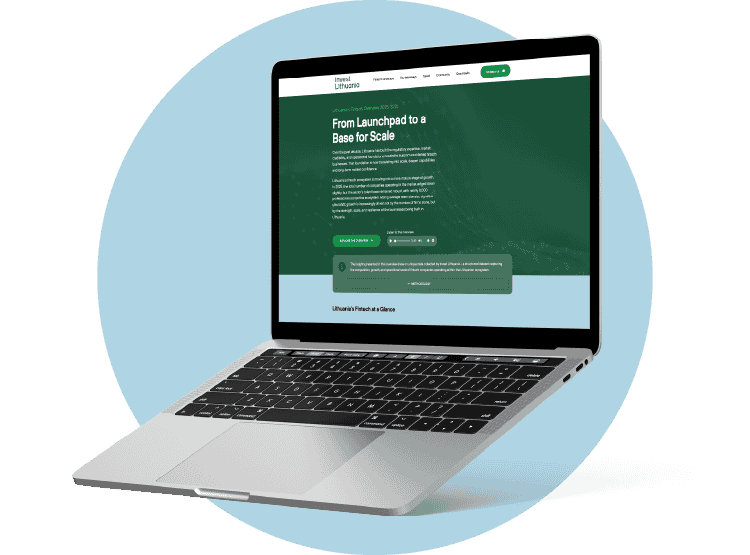
Lithuania’s Fintech by the numbers
Explore the data, trends, and insights shaping Lithuania’s fintech ecosystem in our Lithuania’s Fintech Overview 2025–2026
Recent fintech acquisitions involving Lithuania
Several recent transactions illustrate how Lithuania-linked fintech companies are becoming part of Europe’s broader consolidation trend.
- Checkout.com acquiring Blue EMI
- Ebury acquiring ArcaPay
- Zilch announcing plans to acquire Fjord Bank
- Lloyds Banking Group acquiring Curve Europe
Viewed individually, these may appear to be isolated deals. Taken together, they suggest something more significant: global financial institutions and fintech players increasingly see Lithuania-linked companies as strategic platforms for growth, not simply as local market participants.
In the case of Checkout.com’s acquisition of Blue EMI, Founder and CEO Guillaume Pousaz stated that the transaction would help the company continue delivering innovation in a rapidly evolving digital economy. Similarly, Ebury described its acquisition of ArcaPay as a strategic move that combines local expertise with international reach.
The message is clear: buyers increasingly value what Lithuania’s fintech ecosystem has built.
What fintech investors are really buying
The most valuable assets in fintech acquisitions are often not the licences themselves.
Increasingly, investors are buying:
- Regulatory expertise
Licensed companies bring established relationships with regulators and deep knowledge of compliance requirements.
- Operational infrastructure
Acquiring a functioning business often means acquiring tested processes, systems, and governance frameworks.
- Talent
Lithuania’s fintech sector has developed a strong base of compliance specialists, risk managers, engineers, and payments professionals.
- Market access
Licensed fintech companies operating from Lithuania can provide access to customers and opportunities across the European Union.
In many cases, these capabilities are significantly harder to build than technology itself.
What comes next for Lithuania’s fintech ecosystem?
The themes currently shaping fintech – agentic AI, embedded finance, stablecoins, digital identity, and instant payments – all point in the same direction. The next phase of fintech competition will reward companies with scale, deep regulatory infrastructure, and proven technology capabilities.
For players that lack any of those, acquisition is often faster than building. That structural logic is unlikely to ease, which means the consolidation visible today is more likely a beginning than a peak.
Fintech M&A is a sign of ecosystem maturity
For years, Lithuania’s fintech story was measured by licences issued, companies launched, and investment attracted.
Today, a more meaningful signal is emerging.
Fintech acquisitions demonstrate that global financial institutions are willing to place tangible value on companies, capabilities, and expertise developed in Lithuania.
Rather than viewing M&A solely as an exit event, it should also be viewed as a validation event.
Every acquisition is, in effect, an external valuation of what Lithuania has spent a decade building. And as the next wave of fintech competition – shaped by AI, embedded finance, and digital assets – demands even greater scale and capability, the assets concentrated here are only becoming more strategically valuable.
And that may be one of the strongest indicators yet that Lithuania’s fintech ecosystem has entered a new stage of maturity.

Enjoy reading our news?

Want to learn more about the latest updates?
Invest Lithuania is here to keep you informed about the latest news, opportunities, and developments shaping Lithuania’s business landscape. If you have any questions or would like more details, feel free to contact us—we’re here to provide the insights you need.
- Share now:
-

-

-

-
