


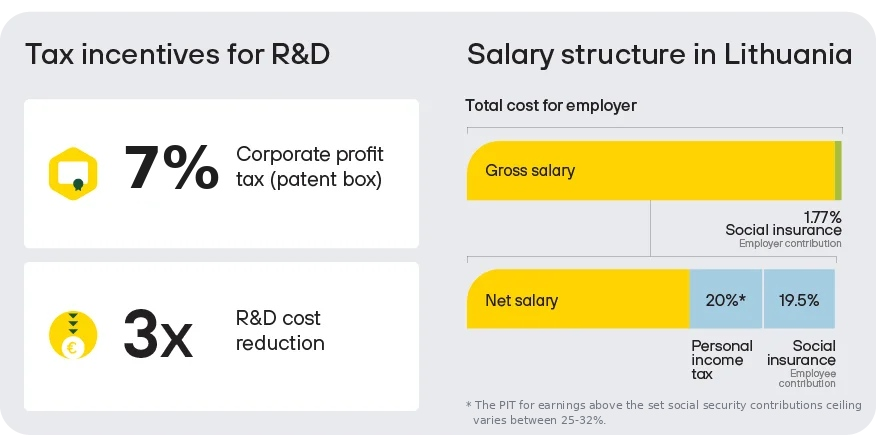
The standard corporate tax rate in Lithuania is 17%. Small businesses may qualify for a reduced rate of 7%, while credit institutions are subject to a higher rate of 22%. Additional tax incentives are available for companies investing in R&D and technology.

Taxes in Lithuania: income, corporate, VAT & more explained
Last updated: May 28, 2026
According to the 2025 International Tax Competitiveness Index (ITCI) by the Tax Foundation, Lithuania ranks fifth globally for tax competitiveness – a position that reflects the country’s consistent commitment to a transparent, business-friendly fiscal environment. Additionally, the Business-Friendly City Perception Index by Emerging Europe has crowned Vilnius the most business-friendly city in emerging Europe. What is the secret behind these excellent numbers?
Lithuania’s tax system is structured to align with European Union (EU) regulations, offering a transparent and investor-friendly environment. The system encompasses various taxes in Lithuania, including personal income tax, corporate tax, value-added tax (VAT), and social security contributions, each playing a vital role in the country’s fiscal framework.
Overview of the Lithuanian tax system
Lithuania’s taxation framework is designed to support economic growth while ensuring compliance with EU standards. The system provides certain tax incentives to attract foreign investment and stimulate business development. For instance, companies investing in research and development (R&D) activities may benefit from tax deductions, promoting innovation within the economy.
Personal income tax in Lithuania
As of 2026, personal income tax rates in Lithuania are structured as follows:
- 20% tax rate applies to annual income up to €82.962.
- Income exceeding €82.962 is taxed at 25%.
- 32% tax rate applies annual income exceeding €138.270.
You can find more information: PwC Tax Summaries.
These rates apply to various forms of income, including employment earnings and payments to board members. Social security contributions are also deducted from gross income, affecting the net take-home pay of employees.
Corporate tax in Lithuania
The corporate tax rate in Lithuania is set at 17%, applicable to most businesses. However, credit institutions are subject to a higher rate of 22%.
Find out more information: Grant Thornton.
Tax incentives for corporates
The government offers tax incentives to encourage investment, particularly in sectors like technology and manufacturing.
- Small companies may benefit from a reduced tax rate of 7% under certain conditions, fostering the growth of small and medium-sized enterprises (SMEs).
- Large-scale projects* can benefit from 0% corporate tax for 20 years, as part of the Investment Highway initiative.
*T&Cs apply. Learn more about eligibility criteria here.
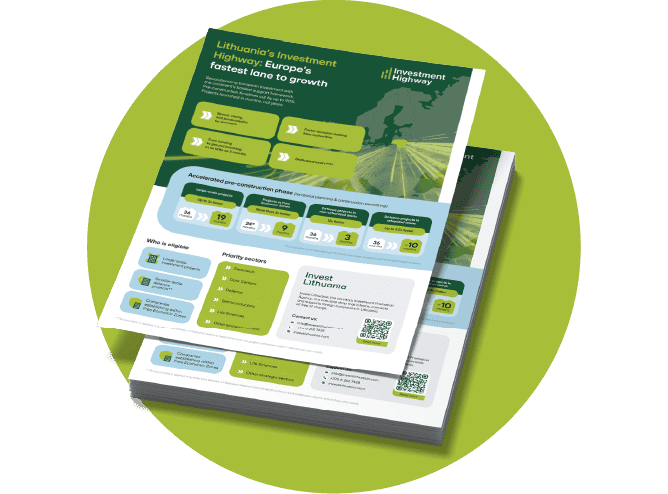
Investment Highway made simple
Your one-page briefing on Europe’s fastest lane to growth.
Value-added tax (VAT) and other indirect taxes
Lithuania imposes a standard VAT rate of 21% on goods and services. Reduced rates of 12% and 5% apply to specific items, such as books, periodicals, and certain pharmaceuticals. Additionally, excise duties are levied on products like alcohol, tobacco, and energy, contributing to the country’s indirect tax revenue.
Property tax and wealth-related taxes
Property tax in Lithuania is levied on real estate owned by individuals and entities. The tax rate ranges from 0.3% to 3% of the property’s value, depending on the municipality and the property’s use. Notably, as of 2026, a primary residence is tax-exempt up to a value of €450,000, with only the excess value being subject to taxation.There are no specific wealth taxes; however, certain luxury items may be subject to higher excise duties.
Social security contributions and employee taxation
Both employers and employees are required to make social security contributions. Employees contribute 19.5% of their gross salary, while employers contribute an additional 1.77%.
Find out more information: Grant Thornton.
These contributions fund various social benefits, including pensions and healthcare, and are deducted from the employee’s gross income, impacting the net salary received.
Tax residency rules in Lithuania
An individual is considered a tax resident in Lithuania if they meet any of the following criteria:
- Permanent residence: The individual has a permanent place of residence in Lithuania.
- Duration of stay: The individual spends 183 days or more in Lithuania within a tax year.
- Center of interests: The individual’s personal or economic interests are closely related to Lithuania.
Tax residency determines the scope of taxable income, with residents taxed on their worldwide income and non-residents taxed only on Lithuanian-sourced income.
Tax return filing in Lithuania
Tax residents are required to file annual tax returns by May 1st of the following year. The process involves reporting all taxable income and calculating the tax liability. Necessary documents include income statements and records of deductible expenses. Late filings may result in penalties, emphasizing the importance of timely compliance.
Double taxation treaties
Lithuania has established double taxation treaties with numerous countries to prevent the same income from being taxed in both jurisdictions. These treaties facilitate cross-border trade and investment by providing clarity on tax obligations. Major partner countries include Germany, the United States, and the United Kingdom.
Withholding tax in Lithuania
Withholding tax applies to certain types of income paid to non-residents, such as dividends, interest, and royalties. The standard withholding tax rate is 17%, but this may be reduced or exempted under applicable double taxation treaties. Entities making such payments are responsible for withholding and remitting the tax to the authorities.
Understanding the Lithuanian tax system is crucial for individuals and businesses operating within the country. The structured framework, aligned with EU standards, offers clarity and opportunities for taxpayers, contributing to a stable and attractive environment for investment and economic activity.
FAQ
-
What is the corporate tax rate in Lithuania?
-
How much income tax do individuals pay in Lithuania?
Personal income tax in Lithuania is 20% on annual earnings up to €82.962. Income between that threshold and €138,270 is taxed at 25%, while any earnings beyond that are subject to a 32% rate. Employees also contribute 19.5% of their gross salary toward social security, which funds pensions, healthcare, and other benefits.
-
What is the VAT rate in Lithuania?
The standard VAT rate in Lithuania is 21%. Reduced rates of 12% and 5% apply to specific goods and services, including books, periodicals, and certain pharmaceuticals. Businesses with annual turnover exceeding €45,000 are required to register for VAT.

Enjoy reading our news?

Want to learn more about the latest updates?
Invest Lithuania is here to keep you informed about the latest news, opportunities, and developments shaping Lithuania’s business landscape. If you have any questions or would like more details, feel free to contact us—we’re here to provide the insights you need.
- Share now:
-

-

-

-
