Lithuania cuts fintech red tape with risk based regulations

Fintech in Lithuania: Why the country is one of Europe’s leading fintech hubs

March 31, 2026


Key takeaways:

  • Lithuania is home to 248 fintech companies that serve 40 million customers across the EU
  • The Bank of Lithuania offers one of the EU’s fastest licensing processes, enabling companies to passport services across all EU member states
  • 65% of Lithuanian fintech firms expect revenue growth in 2026, with 32% expecting growth of 50% or more
  • Sectors once considered niche – including nuclear, critical minerals, and industrial decarbonisation – grew from under 5% to over 33% of VC funding in recent years
  • Vilnius GDP per capita sits 5% above the EU average, making it the wealthiest city in the Baltics and a competitive base for fintech operations
  • Foreign fintech companies benefit from R&D deductions of up to 3x expenses, 0% tax on vested stock options, and up to €2 million in innovation grants

Over the past decade, fintech in Lithuania has transformed from a niche ecosystem into one of Europe’s most attractive and dynamic hubs for financial technology companies. That shift was recently highlighted by Forbes, which described Lithuania as “one of Europe’s most surprising fintech hubs,” reflecting the country’s growing visibility as a credible and fast-scaling location for fintech innovation.

With a combination of business-friendly regulation, strategic geographic positioning, and fast-growing expertise, Lithuanian fintech ecosystem stands out not only in the Baltic region but across the EU.

For investors exploring opportunities to invest in fintech, Lithuania offers measurable growth, strong institutional support, and a thriving community of fintech innovators.

A thriving fintech ecosystem backed by strong numbers

Lithuania’s fintech ecosystem continues to scale impressively, according to the Lithuania’s Fintech overview 2025 by Invest Lithuania.

Key Fintech in Lithuania statistics:

  • 248 fintech companies currently operate in Lithuania, marking a record high number of active firms.
  • These fintech companies in Lithuania serve around 40 million customers across the EU.
  • The sector employs 7,800+ professionals, with more than half of firms employing international talent.
  • 58% of fintech businesses operating here have international staff in their Lithuanian offices, underlining the country’s global appeal.
  • Payments companies represent roughly 40% of the ecosystem, with strong representation from blockchain, digital banking, and financial software sectors.
  • Around 65% of fintech firms expect revenue growth in 2026; with 32% expecting growth of 50% or more.

These figures reflect a maturing marketplace where fintech in Vilnius and other high-growth sectors (including tech, life sciences, defence, and AI) support sustainable growth, innovation, and cross-border scalability, with over 1,100 companies employing more than 40,000 professionals.

Indeed, according to Eurostat data, Vilnius is not only the largest city in the Baltics but also the wealthiest, with GDP per capita currently:
  • 5% above the EU average;
  • 9% higher than Tallinn (Estonia);
  • 36% higher than Riga (Latvia).
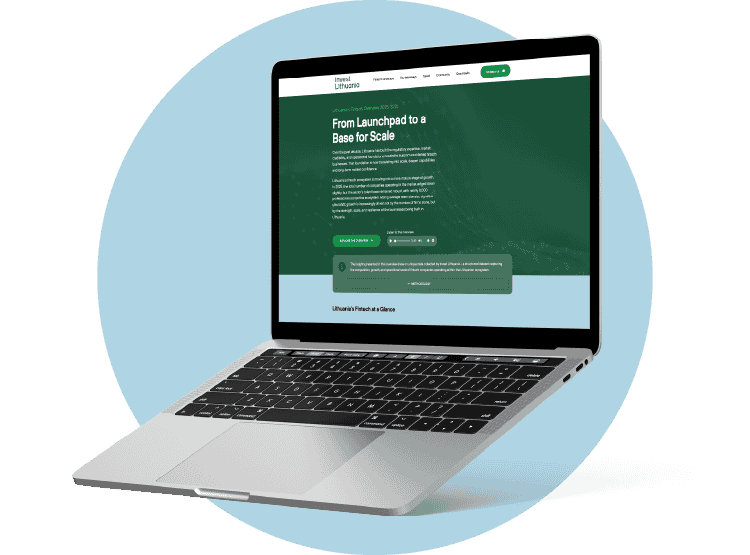
Fintech overview 2026 cta

Lithuania’s Fintech by the numbers

Explore the data, trends, and insights shaping Lithuania’s fintech ecosystem in our Lithuania’s Fintech Overview 2025–2026

Strategic advantages for investors

1. EU Market access and licensing efficiency

One of Lithuania’s most compelling strengths for fintech investors is its access to the European single market. A license granted by the Bank of Lithuania allows fintech firms to passport services across the EU, boosting cross-border operations without additional licensing in each member state.

Lithuania is known for one of the EU’s fastest and most transparent licensing processes, often completed within months rather than years in other jurisdictions. This efficiency accelerates time-to-market for companies looking to scale rapidly across Europe.

2. Progressive and supportive regulatory framework

The Bank of Lithuania has developed targeted initiatives designed to support fintech innovation while maintaining stability and risk control. Notable programmes include:

  • Newcomer Programme: a one-stop consultation and licensing guidance service.
  • Regulatory Sandbox: real-time testing of financial products under supervision.
  • CENTROlink: direct access to SEPA payments infrastructure.
  • DAMAMA: a modern data ecosystem that streamlines compliance and reporting.

These tools help fintechs innovate and scale quickly with lower regulatory friction relative to many Western European markets.

3. Competitive tax and investment incentives

Lithuania offers a suite of financial incentives that make it attractive to foreign investors:

  • 3× R&D expenses deduction – enhances innovation economics.
  • 10–20% employment cost reimbursement for foreign companies.
  • €2 million innovation grants for R&D in designated regions.
  • 5% reduced corporate tax rate on profits from patented products.
  • 0% tax on stock options after vesting employees.
  • Relocation support grants to facilitate international talent mobility.

These incentives not only reduce operational costs but also enhance long-term competitiveness for firms looking to invest in fintech in Lithuania.

A skilled workforce and vibrant innovation environment

Lithuania’s fintech success is driven by high-quality talent and robust digital infrastructure:

  • The sector’s nearly 8,000 specialists demonstrate a strong and growing skills base.
  • The wider Lithuanian tech ecosystem has scaled rapidly, with the national startup value exceeding €16 billion and strong venture capital interest, as reported by Startup Lithuania.
  • According to the country’s capital development agency, Vilnius has established itself as a central node in the fintech ecosystem, attracting significant investment, skilled professionals, and corporate HQs.

Importantly, Lithuania delivers a balanced ecosystem where technical, compliance, and business development functions thrive in parallel, positioning the country as a full-service fintech hub rather than a niche outpost.
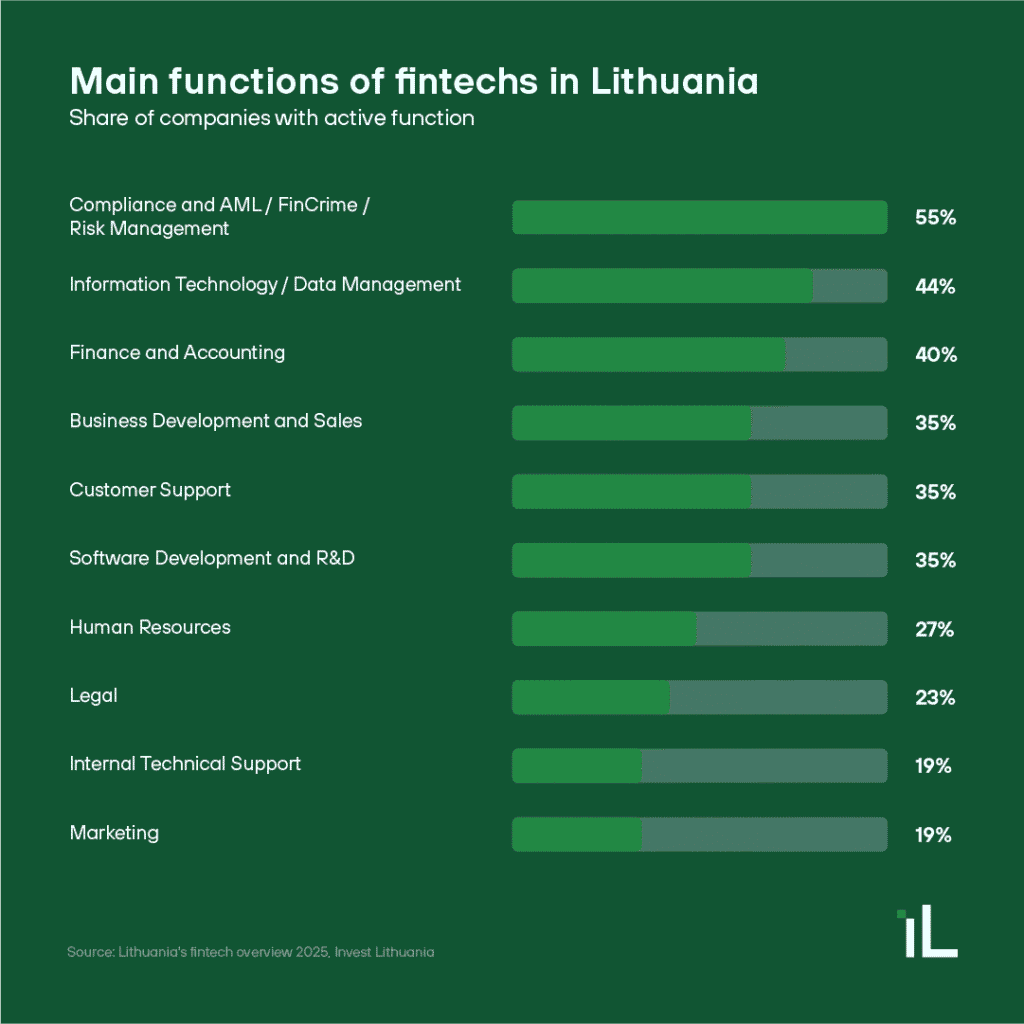
The main functions of fintechs in Lithuania

Why Lithuania is special for fintech investors

Compared to other EU market, Lithuanian fintech stands out because of:

  • Speed and clarity of licensing compared with slower, more opaque processes elsewhere in the EU.
  • Integrated EU market access for financial services.
  • High innovation incentives and low business costs.
  • Robust digital talent and diverse company base.
  • Mature regulatory support without undue risk exposure.

These factors enable Lithuania to attract both emerging startups and established fintech companies  looking to scale efficiently across Europe.

Lithuania – a strategic destination for global companies to invest in fintech

As fintech markets mature globally, Lithuania has carved out a competitive edge within the EU that blends regulatory savvy, market access, talent, and innovation incentives. For investors evaluating their next move, the country’s thriving ecosystem indicates a strong potential for growth, scalability, and sustainable returns.

Whether you are looking to expand a fintech startup or invest in fintech operations at scale, Lithuania represents a compelling gateway to Europe’s digital finance future.


Subscribe CTA image

Enjoy reading our news?

Please wait...

Thank you for subscribing to our newsletter!

Contact us

Want to learn more about the latest updates?

Invest Lithuania is here to keep you informed about the latest news, opportunities, and developments shaping Lithuania’s business landscape. If you have any questions or would like more details, feel free to contact us—we’re here to provide the insights you need.