


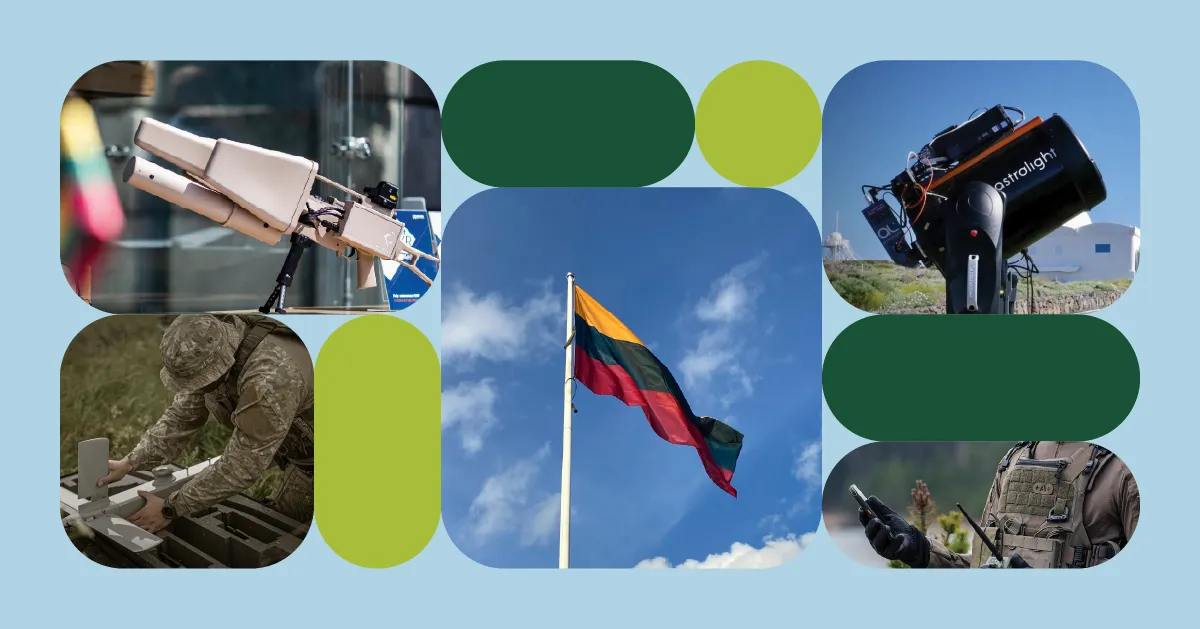
Lithuania’s defence startups: investment opportunities turning into future-focused miltech solutions
Lithuania’s defence industry is entering a new growth phase, driven by rising national security priorities, increasing defence investment and a rapidly developing ecosystem of dual-use and military technology companies.
Between 2018 and 2023, employment in Lithuania’s defence industry grew by an average of 14% annually – twice the national average – reflecting the sector’s expanding industrial and technological base.
In 2024, Lithuania’s defence and dual-use sector turnover reached approximately €960 million, while the ecosystem included around 100 innovative companies working across UAVs, lasers and photonics, ICT, advanced engineering, sensors, autonomous systems and secure communications.
This momentum is being reinforced by Lithuania’s rising defence budget, which is set to reach €4.79 billion in 2026, around 5.38% of GDP. This sends a strong long-term demand signal to defence manufacturers, technology providers and investors. Together, these factors are positioning Lithuania as an emerging hub for military technology innovation on NATO’s eastern flank, attracting both local startups and established global defence companies.
Global defence giants invest in Lithuania
A major milestone came in 2025, when Rheinmetall officially started construction of its 155 mm artillery ammunition plant in Lithuania. The project, backed by major investment, is expected to create more than 150 highly qualified jobs and produce tens of thousands of artillery shells annually, strengthening Lithuania’s role in Europe’s ammunition supply chain.
Lithuania has also strengthened its defence cooperation through a partnership with Northrop Grumman. In September 2024, the US manufacturer signed a Memorandum of Understanding to support local suppliers in producing medium-caliber ammunition for Infantry Fighting Vehicles.
Another recent industrial milestone is Lithuanian Defence Services’ nearly €50 million investment in the Kaunas Free Economic Zone, where Leopard 2A8 tank assembly and advanced military equipment manufacturing are set to be developed.
Military technology innovation in Lithuania
Lithuania’s miltech ecosystem is built around dual-use technologies where the country already has strong industrial and scientific capabilities: drones and autonomous systems, anti-drone solutions, laser and photonics technologies, secure communications, sensors, AI-enabled battlefield systems and space-to-ground optical communication.
This gives Lithuania a specific advantage in defence innovation. Instead of competing only in traditional heavy defence manufacturing, the country is building strength in faster-moving technologies that can be tested, adapted and scaled quickly.
Lithuania’s defence innovation pipeline is supported by initiatives such as the MilTech Sandbox, defence innovation vouchers, Miltech Academy, Baltic Miltech Summit and the €300 million Vytis initiative. Together, these tools are designed to help companies move from early-stage ideas to prototyping, testing, procurement and export.
Battlefield feedback from Ukraine has accelerated product development cycles, helping Lithuanian companies refine drones, counter-UAS systems, communications tools and soldier-level technologies in real operational conditions.
Companies such as Unmanned Defense Systems, RSI Europe, Granta Autonomy, NT Service, Brolis, Aktyvus Photonics and Astrolight show how Lithuania’s strengths in engineering, lasers, electronics and software are being redirected into high-value defence and dual-use applications.
Lithuanian defence startups and scaleups to watch
The defence startup ecosystem in Lithuania features several companies leveraging the country’s strengths in telecommunications, lasers, and sensor technologies:
1. Granta Autonomy
The company started as a software development company in 2009 before expanding into military applications after 2014. Their Hornet XR autonomous unmanned aerial vehicle systems have gained recognition, and in September 2024, they secured a €1 million contract to supply GA-10FPV-AI quadcopter drones to both Lithuanian and Ukrainian armed forces.
2. RSI Europe
The company specialises in remote-controlled systems, FPV drones and UGVs for the defence sector. Its Shpak FPV quadcopter uses fibre-optic guidance designed to resist electronic warfare.
3. NT Service
The company develops anti-drone systems and cellular jamming technologies. Their portable EDM4S SkyWipers have been battle-proven in Ukraine and are currently used by Lithuanian, Ukrainian, and Romanian armed forces.
4. Astrolight
The business develops space-to-ground laser communication solutions for secure, high-throughput data links. Selected among NATO DIANA’s top innovators, the company adds a space and secure communications dimension to Lithuania’s miltech ecosystem.
5. Brolis Defence Group
The company has leveraged Lithuania’s laser and photonics expertise to develop advanced electro-optical and laser systems for defence and security applications. Its solutions include dismounted soldier systems, laser aiming devices and border surveillance technologies, serving armed forces in more than 40 countries. In 2026, the company announced a majority stake acquisition by ETNA Equity Fund, described by Brolis as the largest defence sector transaction in the Baltics to date.
6. Aktyvus Photonics
Ranked among top 10 European defence startups by Sifted, the business specializes in robust laser technology designed for extreme conditions. The company develops high-performance lasers that can withstand harsh environments including extreme temperatures, shock, and humidity for various defence applications.
7. Unmanned Defense Systems
The company researches, develops, and manufactures tactical military UAV systems with a focus on advanced swarm technology solutions. In 2024, the company secured €3.2 million in funding to advance AI-based swarm drones and supplies its ISTAR and long-range loitering munition platforms to Lithuanian and Ukrainian armed forces, as well as other EU members and NATO allies.
8. Broswarm
The company develops mine detection solutions using sensor arrays and sensor fusion, adding another layer to Lithuania’s defence technology ecosystem beyond drones and laser systems.
Battlefield-tested defence solutions with global reach
Lithuanian-made defence solutions have been battle-tested in Ukraine, providing an invaluable advantage for defence innovation companies. Close collaboration between the two countries ensures real-time feedback reaches Lithuanian manufacturers, helping them develop more effective battlefield solutions.
Lithuanian defence companies have expanded their reach well beyond Ukraine. NT Service’s SkyWipers anti-drone systems are now used by the Romanian Armed Forces, while Brolis Defence Group serves armed forces in more than 40 countries, including NATO and allied markets.
For investors exploring opportunities in the defence industry, this combination of battlefield-proven technologies and growing NATO integration demonstrates the sector’s increasing international competitiveness and makes a compelling case for investing in Lithuania’s defence sector.
Why is Lithuania emerging as a strategic defence investment location?
Lithuania is becoming a strategic defence investment location for several reasons: its position on NATO’s eastern flank, rising national defence spending, faster setup procedures for defence companies, a growing dual-use startup ecosystem and increasing integration into European and transatlantic defence supply chains.
Lithuania’s rising defence spending sends a strong demand-side signal to manufacturers, technology providers and investors. At the same time, projects such as Rheinmetall’s 155 mm ammunition plant and Northrop Grumman’s cooperation on medium-calibre ammunition show that Lithuania is already moving from defence policy ambition to industrial execution.
For a broader analysis of Lithuania’s defence investment environment, read our related article on Lithuania’s approach to growing the defence sector.

What makes Lithuania’s Defence industry stand out?
Explore a fast-growing ecosystem where advanced tech, state investment, and a skilled workforce drive innovation in telecommunications, lasers, sensors, and next-gen military equipment.
Defence investment opportunities in Lithuania
Lithuania’s defence sector offers investment opportunities across military technology, dual-use innovation, defence manufacturing, drones, counter-UAS systems, lasers, secure communications and advanced sensors.
As defence spending rises and global supply chains shift, Lithuania is increasingly well positioned as a location for defence startups, scaleups and established manufacturers looking to develop, test and scale future-focused miltech solutions in the EU and NATO market.

Enjoy reading our news?

Want to learn more about the latest updates?
Invest Lithuania is here to keep you informed about the latest news, opportunities, and developments shaping Lithuania’s business landscape. If you have any questions or would like more details, feel free to contact us—we’re here to provide the insights you need.
- Share now:
-

-

-

-
