


- Follow us!
-

-

-

-


Artificial intelligence is rapidly reshaping global economies, yet its development remains highly concentrated. Most advanced AI models are built in just a handful of countries, while data from the International Energy Agency (2024) shows that the United States and China together account for around 70% of global data centre capacity. As Europe seeks greater technological resilience and reduced dependency on external powers, the Baltics – and Lithuania in particular – are positioning themselves as a pragmatic, future-focused alternative.
For investors exploring how to invest in AI technology within the European Union, Lithuania offers a compelling mix of early policy leadership, deep tech capabilities, competitive talent, and growing AI infrastructure in Europe.
Lithuania was among the first EU member states to adopt a national AI strategy back in 2018 – the second such document in the European Union. This early move signalled both political awareness and long-term strategic thinking.
Today, the Ministry of Economy and Innovation continues to actively shape the AI ecosystem. Between 2021–2026, €42.35 million has been allocated to develop 23 Lithuanian-language AI resources for business. A further €10 million has been directed toward AI product development in central and western Lithuania, while in 2025 a Lithuanian consortium secured €65 million for the establishment of the “LitAI” centre, a unique AI innovation hub in the Baltics.
Most recently, the government established GovAI, an AI competence centre for the public sector. The centre provides AI-related consulting, methodological support, training, and regulatory “sandbox” opportunities. This reinforces Lithuania’s ambition to lead not only in AI adoption but also in responsible governance.
Following the entry into force of the EU AI Act, businesses operating in the EU must comply with new regulatory requirements. For many startups, this presents financial and administrative challenges.
Lithuania is among only three EU Member States that have already appointed dedicated national authorities for the EU AI Act: the Regulatory Communications Authority acts as the AI market surveillance authority and single point of contact, while the Innovation Agency serves as the notifying authority. This dual-institution model ensures clarity, speed, and institutional specialization in regulatory execution.
Building on this foundation, Lithuania was also among the first countries to announce a regulatory AI sandbox. According to the Lithuanian Innovation Agency, the programme operates on multiple levels, offering public consultations and open guidance, as well as a selective track for high- and medium-risk AI solution developers. Over three years, five cohorts of selected companies will receive structured expert consultations, cybersecurity audit services, and even access to high-performance computing infrastructure.
In a fragmented European deep tech environment, regulatory clarity combined with practical support can become a decisive factor for AI companies seeking scalable growth within the EU single market.
In November 2025, the European Commission proposed linking the application of requirements for high-risk AI systems to the availability of harmonised standards and supporting compliance tools. Under this approach, the rules for high-risk systems would apply within a maximum of 16 months after the Commission confirms that the necessary standards and technical guidance are in place.
This adjustment provides greater legal certainty for companies developing high- and medium-risk AI solutions. For Lithuania, which has already designated competent national authorities and established a regulatory sandbox framework, the revised timeline creates an opportunity to offer structured compliance support and reduce implementation costs for AI developers operating within the EU market.
AI leadership requires more than infrastructure: it especially requires people.
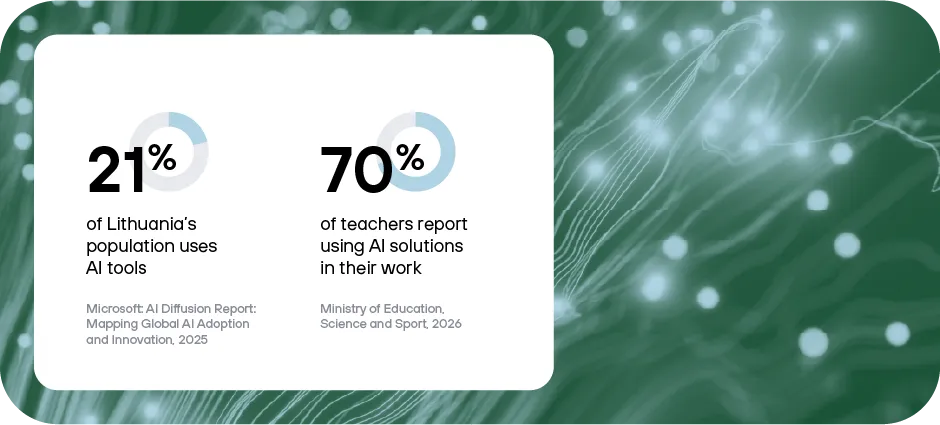
According to a recent Microsoft report, 21% of Lithuania’s population already uses AI tools. In education, 2026 statistics from the Ministry of Education, Science and Sport confirms that nearly 70% of teachers report using AI solutions in their work. The government has allocated €1.7 million for AI-related software licences in schools, including Microsoft Copilot tools. Additionally, private sector initiatives such as Tesonet’s national programme provide global AI tools to Lithuanian schools free of charge.
This systematic investment strengthens the pipeline of AI talent that Lithuania can offer international investors. The country consistently ranks among Europe’s digital leaders, and its concentration of engineering expertise has long supported globally competitive fintech, cybersecurity, and deep tech ventures.
For companies searching for machine learning engineers in Lithuania, the ecosystem combines strong STEM education, multilingual talent, and cost competitiveness compared to Western European hubs.
AI and deep tech development go hand-in-hand – and the Baltics have demonstrated strong momentum. Since 2018, the combined value of Baltic deep tech startups has more than tripled. AI-powered startups now represent over half of the ecosystem’s value.
According to the Dealroom Baltic Deep Tech Report 2024, while Europe still lags behind the US and China in generative AI investment (attracting only 9% of global generative AI VC in 2024) Lithuania’s deep tech expertise provides a foundation for growth. The country’s startup ecosystem value surpassed €16.4 billion in 2025, supported by 77 unique venture capital investors in a single year.
Although Lithuania currently captures a modest share of global AI investment Europe-wide, this gap presents opportunity. As EU policymakers prioritise digital sovereignty and diversified AI infrastructure Europe-wide, agile and specialised ecosystems like Lithuania can scale faster than larger, more rigid markets.
AI growth is inseparable from data centre expansion. Globally, concerns are rising about energy availability and infrastructure concentration.
Lithuania offers a strategic advantage: energy independence ambitions, growing renewable capacity, and available land for sustainable infrastructure development.
According to the Ministry of Energy, the country plans to reach 100% renewable electricity consumption by 2028, one of the most ambitious renewable energy targets in the European Union. Additionally, as reported by Eurostat (2025), 76% of Lithuania’s total electricity production already comes from renewable energy sources.
Beyond physical infrastructure, Lithuania is also investing in sustainable AI research capacity. A newly established centre by Kaunas university of technology (KTU) is dedicated to advancing energy-efficient and environmentally responsible artificial intelligence solutions, reinforcing the country’s focus on long-term, sustainable AI development.
Simultaneously, investment in digital infrastructure continues to scale. For example, Telia is investing €26 million in a new data centre near Vilnius, strengthening local data security, resilience, and sovereign storage capacity.
For investors evaluating AI engineering hubs potential in Lithuania, this combination of infrastructure readiness, renewable energy integration, and research capability is increasingly attractive.
Unlike the US model driven by speed or China’s state-centric approach, Europe is building a third path: one rooted in ethical, transparent and citizen-oriented AI development. Lithuania’s sandbox initiatives, early strategy adoption, and public-sector competence centre demonstrate its commitment to this balanced model.
Lithuania does not yet lead globally in AI adoption. Only 9% of Lithuanian companies use AI technologies, compared to a 14% EU average. Scaling enterprise-level AI adoption and attracting larger volumes of European AI investments remains a priority.
However, the combination of regulatory preparedness, deep tech capability, public-private collaboration, and growing AI infrastructure suggests that Lithuania is not merely catching up but positioning itself strategically within Europe’s AI future.
For international investors asking where the next competitive AI ecosystem in Europe will emerge, Lithuania and the Baltics present a credible answer.
With early policy leadership, expanding AI infrastructure, strong engineering talent, regulatory support mechanisms, and a rapidly maturing deep tech ecosystem, Lithuania is emerging as one of the most strategically positioned AI engineering hub in Europe.
In a global environment defined by concentration and fragmentation, Lithuania offers something different: a scalable, responsible, and strategically positioned gateway for AI growth in the European Union.


Invest Lithuania is here to keep you informed about the latest news, opportunities, and developments shaping Lithuania’s business landscape. If you have any questions or would like more details, feel free to contact us—we’re here to provide the insights you need.


