


Explore a growing business services ecosystem with skilled talent, strong expertise, and the flexibility to scale complex operations.
- Follow us!
-

-

-

-


This article draws on an interview with Rajesh Kumarapuram, GBS and GPO Lead at BMI Group, conducted as part of the GBS Director Interview Series by Thom Barnhardt, Founder and CEO of European Business Services.
Rajesh Kumarapuram, GBS and GPO lead at BMI Group, explains why running ERP implementation and shared services transition simultaneously is one of the costliest mistakes in GBS, and how Vilnius is being rebuilt into a genuine global business services value center.
Rajesh Kumarapuram has built global business services (GBS) centers at scale before. At GSK, he established a finance hub in Poznań that grew to 2,500 people and stood up a Global Capability Center in Bangalore with a headcount of 2,000.
When he joined BMI in the summer of 2024 to lead its GBS and GPO function, he arrived with clear-eyed expectations. What he found was a transformation program that showed, in precise detail, how sequencing decisions made years earlier were still creating friction in the operating model today.
His account of BMI’s GBS journey is one of the more instructive examples from the Vilnius shared services community, precisely because it names the mistakes openly rather than glossing over them with transformation language.
The context matters: Lithuania’s GBS sector has grown to 100 centers and more than 27,000 employees, which makes Vilnius a relevant market for examining how shared services operations mature beyond cost efficiency.
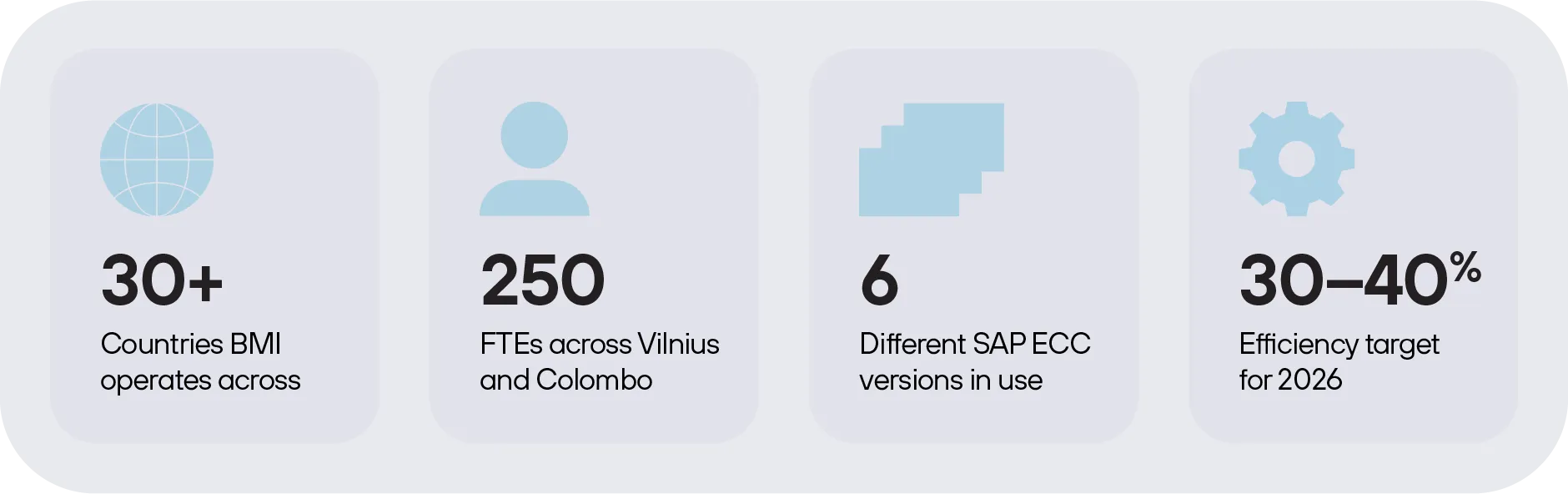
BMI is a roofing business built from three distinct brands: Braas, Monier, and Icopal. That acquisition-led history has a direct operational consequence. Because roofing is an inherently local business – a house in Poland looks nothing like one in Italy, and customer preferences differ by market – each acquired entity arrived with its own processes, systems, and organizational identity.
The finance technology landscape reflects this complexity. BMI operates SAP S/4HANA in roughly ten countries and SAP ECC across the rest, but not a single version of ECC. There are six distinct configurations, each shaped by a different implementation project, none following the same template. Even within S/4 deployments, markets were heavily customized rather than standardized to a common design.
Underneath the systems complexity sits a cultural dynamic that Kumarapuram is direct about: an acquisition-built company tends to produce business units that believe strongly in their own distinctiveness. Instinct is not an obstruction. It is often a genuine conviction that local variation is commercially necessary. Managing that conviction while driving standardization is as much a change management challenge as a process one.
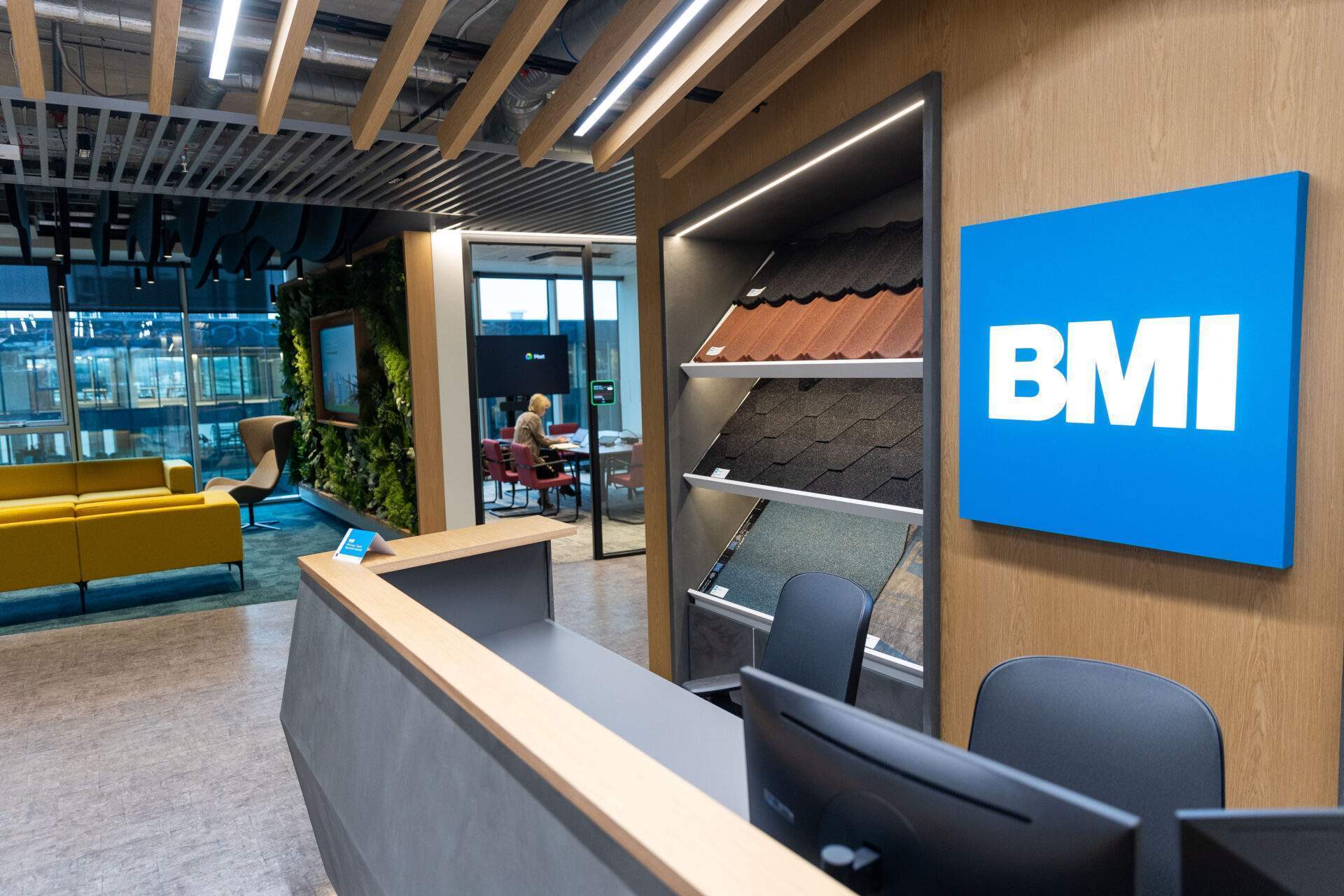
BMI Group’s office in Vilnius. © BMI group
BMI’s GBS center in Vilnius was established through a lift-and-shift transition in 2022. Looking back, Kumarapuram identifies a compound error in how that transition was run – one that is far more common than the industry tends to acknowledge publicly.
The logic is straightforward, but it is routinely violated under pressure from leadership timelines and cost case commitments. A lift-and-shift move relocates work to a shared services center while preserving the process as-is. A standardization program redesigns that process. An ERP implementation changes the system that runs it.
Running all three simultaneously means no single workstream has stable ground to stand on. Change in one dimension constantly destabilizes the others, and accountability for outcomes becomes genuinely unclear.
The result at BMI was an operating model that was inconsistently scoped across markets. The same activity – for example, journal preparation – might sit fully within GBS in one country and be partially retained locally in another, depending on how the original transition was negotiated. That fragmentation has a direct cost: unnecessary handoffs, duplicated communication, and reconciliation overhead that adds no value.
The remediation work now underway at BMI involves consolidating process ownership so that each function sits entirely within one location, rather than being split across Vilnius and the outsourced operation in Colombo with WNS.
Procure-to-pay has already moved entirely to Colombo. Record-to-report is moving to Vilnius. Order-to-cash, which BMI terms lead-to-cash, has also consolidated into Vilnius.
The rationale is clear. When a process such as record-to-report is fragmented, with different people preparing, posting, validating, and reconciling journals across two locations, the communication overhead and handoff friction consume a significant share of available capacity. Consolidating ownership into a single site removes those handoffs and creates the conditions for genuine productivity improvement.
This is the foundation for BMI’s target of 30 to 40 percent efficiency improvement by the end of 2026 – a figure that combines labor arbitrage with productivity gains from process consolidation and standardization.
BMI refers to its Vilnius operation deliberately as a “value center” – a term that signals an ambition beyond transactional efficiency. Kumarapuram draws an explicit parallel to the Global Capability Center model that has emerged in India, where shared services operations have progressively taken on higher-complexity analytical and advisory work rather than remaining purely transactional.
That ambition is currently constrained by the standardisation work still underway. The center handles finance, HR, master data management, FP&A support, supply chain finance, and risk and controls – a broader scope than many Vilnius operations of similar size. But the path to genuine capability center status runs through foundational work: a consistent operating model, clean process design, and technology that connects rather than fragments the business.

Kumarapuram’s position on AI adoption closely reflects what other experienced GBS leaders in Vilnius are saying. BMI uses Ivalua for duplicate invoice checking and automated supplier statement reconciliation within procure-to-pay, and has recently begun exploring the AI capabilities within Celonis – the same process mining platform Johnson Matthey’s Vilnius operation also relies on.
But he is explicit that AI investment needs to follow, not precede, the foundational standardization work. “For us, we want to get these basic foundational elements right first before we start to think about AI. The next stage for us, from an AI perspective, is to start looking at what Celonis can do to help”, adds Rajesh Kumarapuram.
What is striking about the GBS community in Vilnius – based on conversations across multiple director-level interviews – is how consistent this view is. Practitioners with deep operational experience are not dismissing AI. They are sequencing it.
The technology requires clean data, consistent processes, and a stable operating model to deliver on its promise. Organisations that attempt to use AI to fix foundational disorder typically find that it amplifies the problems rather than resolving them.
BMI is building that foundation now. The BMI operation in Vilnius is not yet the GBS value center its leadership intends it to become, but the sequencing decisions being made today will determine whether it gets there.
By consolidating process ownership, reducing handoffs, clarifying global process accountability, and standardizing the technology and operating model underneath, BMI is creating the conditions for Vilnius to move beyond transactional service delivery. The lesson is relevant well beyond BMI: a GBS center becomes more strategic when it reduces complexity and builds the foundations for consistent, higher-value work.


Invest Lithuania is here to keep you informed about the latest news, opportunities, and developments shaping Lithuania’s business landscape. If you have any questions or would like more details, feel free to contact us—we’re here to provide the insights you need.


