


Inside Pentasweet’s €65M bet on brazzein: Europe’s first sweet protein factory
Key takeaways
- Pentasweet is building a €65 million brazzein sweet protein factory in Vilnius, with operations expected in the first half of 2027.
- Brazzein is a natural sweet protein from the West African oubli fruit, described as hundreds to thousands of times sweeter than sucrose.
- Pentasweet uses precision fermentation with food-grade yeast, avoiding dependence on scarce tropical fruit and supporting scalable supply.
- The project has major investment project status, ILTE financing and around 30 highly skilled jobs planned.
- The factory strengthens Lithuania’s position in biotech innovation, food tech and precision fermentation.
Pentasweet Lithuania has begun building a €65 million brazzein sweet protein factory in Vilnius, placing the country at the centre of one of Europe’s notable food-tech scale-up stories. The investment matters beyond one biotech company: it connects sugar reduction, precision fermentation, industrial biotech innovation and the growing biotechnology sector in Lithuania. For food manufacturers asking “what is brazzein?” or “how is brazzein made?”, Pentasweet offers a practical answer: a rare, intensely sweet natural protein can be produced without relying on a scarce tropical fruit supply chain.
What is brazzein?
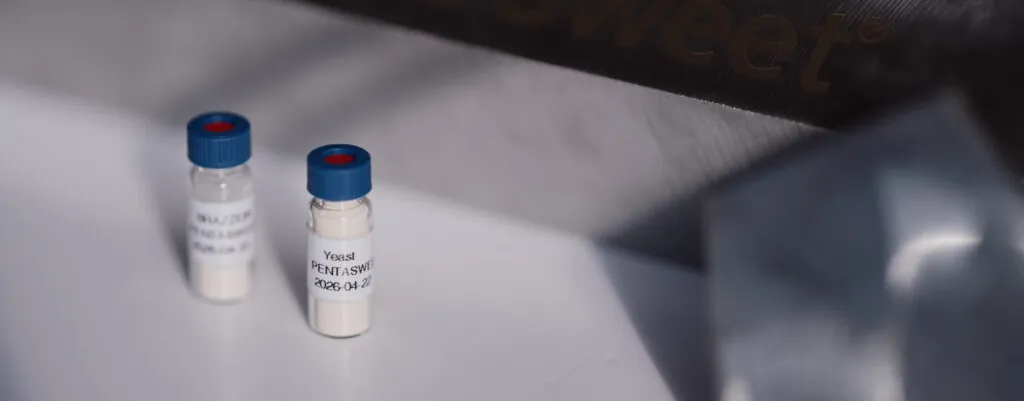
Brazzein is a natural sweet protein found in the West African oubli fruit that can be produced through precision fermentation. Scientific literature identifies brazzein as a high-potency, thermostable protein from Pentadiplandra brazzeana, with sweetness reported at around 500 to 2,000 times that of sucrose depending on the comparison solution.
In simpler terms, brazzein is not sugar and it is not a conventional artificial sweetener. It is a protein molecule that the human palate experiences as sweet. That makes it interesting for food and beverage companies because it can create sweetness at very low use levels. Pentasweet describes its brazzein as up to 1,500 times sweeter than sugar, with a clean taste and very low calorie contribution due to its low use level.
How is brazzein made?
Brazzein is made by engineering food-grade yeast to produce the sweet protein in controlled fermentation tanks. Precision fermentation uses microbial hosts as “cell factories” for specific functional ingredients such as proteins, enzymes, vitamins, flavours or fats.
Q: How is brazzein made without harvesting oubli fruit?
A: Pentasweet engineers food-grade yeast with the instructions to express the brazzein protein. The yeast grows in a controlled fermentation system, the target protein is produced, and the product is then separated and purified. Pentasweet says this avoids dependence on rare plant sources, reduces agricultural variability and creates a consistent, scalable supply.
Q: Is the yeast the final ingredient?
A: No. In precision fermentation, the microorganism is the production host, not the intended ingredient. According to Pentasweet, the final product has no trace of the genetically engineered production host.
Q: What happens to side streams?
A: Pentasweet says the process allows more efficient use of raw materials, with side streams planned for further energy generation such as biofuel production. The company also notes circular-economy potential through by-product use in areas such as agricultural fertiliser or animal feed.
Traditional protein vs. sweet protein
Traditional proteins are consumed mainly for nutrition, while sweet proteins are functional ingredients used to deliver sweetness at very low doses.
| Feature | Traditional protein | Sweet protein |
| Main role | Nutrition, structure, satiety | Sweetness and sugar reduction |
| Typical use level | Grams per serving | Very small inclusion rates |
| Examples | Whey, soy, pea, casein | Brazzein, thaumatin, monellin |
| Product function | Builds texture and protein content | Provides sweet taste |
| Calorie impact | Depends on amount used | Low because use level is tiny |
| Manufacturing route | Agriculture, dairy, extraction or fermentation | Plant extraction or precision fermentation |
| Formulation challenge | Solubility, texture, flavour | Sweetness curve, aftertaste, bulking gap |
Benefits of sweet proteins
Sweet proteins can help food and beverage manufacturers reduce added sugar while maintaining sweetness and product appeal.
Key benefits of sweet proteins include:
- High sweetness intensity: Brazzein can be used at low levels because it is far sweeter than sugar.
- Sugar reduction potential: Pentasweet positions brazzein for full or partial sugar reduction in foods and beverages.
- Application flexibility: Pentasweet highlights potential in dairy, jams, confectionery and protein-fortified products.
- Scalable production: Precision fermentation can reduce dependence on rare plant material and create more consistent supply.
- Logistics efficiency: Low use levels can reduce the volume of sweetening ingredient transported through the supply chain.
Pentasweet’s €65M factory
Pentasweet is building Europe’s first brazzein sweet protein production facility at the Vilnius City Innovation Industrial Park in Lithuania. The project covers more than 8,000 square metres on a 1.2-hectare site and is expected to begin operations in the first half of 2027.
Pentasweet’s expansion project is structured in stages. Phase I will establish core production infrastructure and initial manufacturing capacity, with completion planned for early 2027. After Phase II, total investment is expected to reach €65 million. The full-capacity figure cited by Tvarijonavičius is up to the equivalent of 50,000 tonnes of sugar.
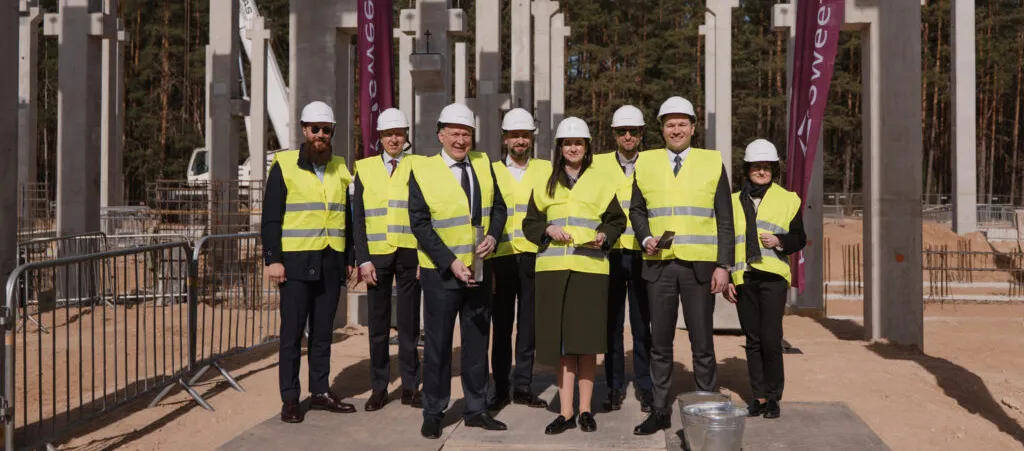
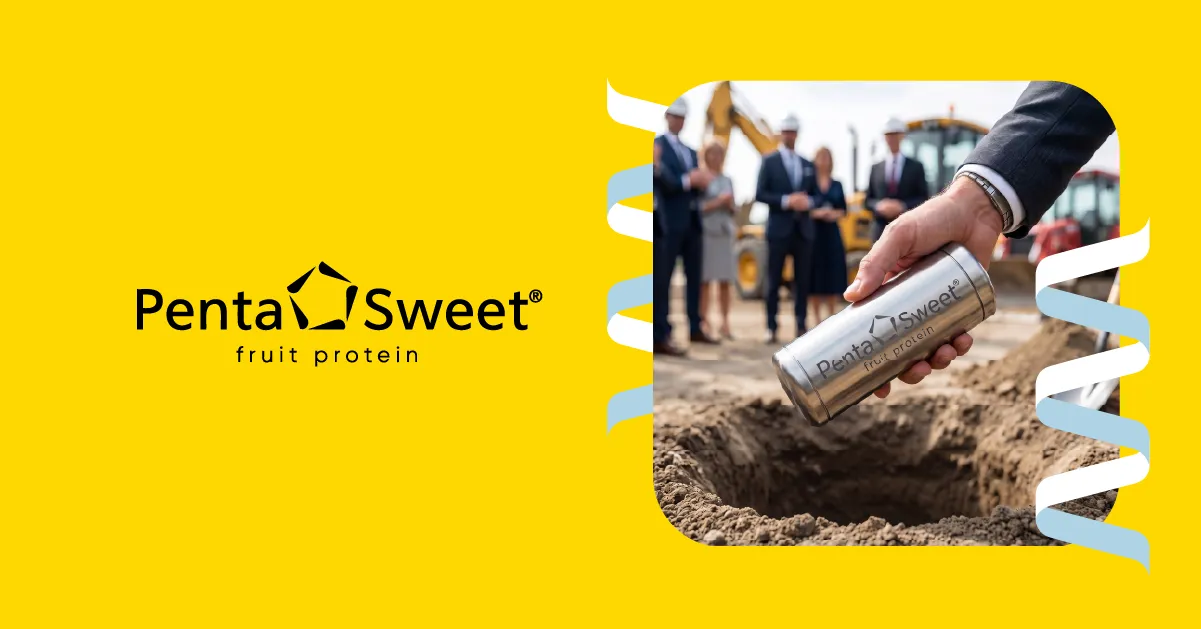
The capsule ceremony for Pentasweet’s future brazzein factory at Vilnius City Innovation Industrial Park. © Pentasweet
Lithuania’s Ministry of Economy and Innovation granted the project major investment project status, and construction is partly financed through a loan from the National Development Bank ILTE. The facility will be mostly automated and is expected to create around 30 highly qualified roles, including biotechnologists, engineers and automation specialists.
The strategic significance of the factory lies not only in its size, but in what it represents: a move from lab-scale food biotech to commercial manufacturing. For European food producers, local brazzein production could provide a precision-fermentation route to a high-intensity sweet protein.
Stakeholders are framing the factory as a proof point for Lithuania’s move from research to manufacturing. Prime Minister Inga Ruginienė described Lithuania as capable of “turning it into real projects,” while Tvarijonavičius called the foundation capsule a step in a “long-developed vision.” Economy and Innovation Minister Edvinas Grikšas added that innovations of this scale “do not happen by chance.”
More details on Pentasweet’s €65 million investment milestone are available in Invest Lithuania’s earlier coverage of the factory development.
Lithuania’s role in European biotech innovation
Lithuania’s life sciences sector contributes 2.6% to national GDP and aims to reach 5% by 2030. The ecosystem has strengths in biotechnology, precision fermentation, CRISPR, bioprocessing and advanced manufacturing, supported by one of the fastest growth rates in the European Union.
The country’s biotech base is increasingly built around scale-up infrastructure. Vilnius City Innovation Industrial Park is Lithuania’s first industrial park dedicated to life sciences, while Bio City is being developed as a major next-generation life sciences district.
Top biotech companies innovating in Lithuania
- Pentasweet – a Lithuanian food-tech biotech company developing clean-taste brazzein through precision fermentation and building Europe’s first dedicated brazzein factory.
- Thermo Fisher Scientific – a global life sciences company with molecular biology products used in workflows such as PCR, cloning, restriction enzyme digests and nucleic acid electrophoresis.
- Northway Biotech – a Vilnius-based end-to-end biologics CDMO specialising in protein-based biologics and gene therapies, with facilities in Lithuania and the US.
- Biomatter – a Vilnius University-origin company using AI to design new enzymes, including de novo enzyme creation through its Intelligent Architecture platform.
- Caszyme – a CRISPR-focused biotech company developing custom gene-editing solutions across healthcare, diagnostics, agri-tech and industrial biotech.
What’s next for Pentasweet and Lithuania’s food tech industry?
Pentasweet’s next milestone is to move from construction to first operations in 2027 while preparing regulatory access for European food manufacturers. The biotech company is initially focusing on Europe and plans to submit a food additive application to EFSA, making regulation the next major step after the factory build-out.
If the project scales as planned, Pentasweet Lithuania will give Europe a new source of brazzein sweet protein and a visible example of how biotech innovation can move from laboratory concept to industrial production. For Lithuania’s food tech industry, Europe’s first brazzein factory is more than a sugar-reduction story; it is a signal that precision fermentation, life sciences talent and high-value manufacturing can converge in Vilnius.

Enjoy reading our news?

Want to learn more about the latest updates?
Invest Lithuania is here to keep you informed about the latest news, opportunities, and developments shaping Lithuania’s business landscape. If you have any questions or would like more details, feel free to contact us—we’re here to provide the insights you need.
- Share now:
-

-

-

-
